Kubernetes clusters
Run Kubernetes clusters where every node, control plane and worker, is a microVM. Because microVMs are small, a single bare-metal host can run nodes for several clusters, and each node still has a hard isolation boundary.
This is a good fit when you want to:
- Run many small clusters on a limited amount of edge or on-prem hardware.
- Give each team or tenant its own cluster without giving each one its own servers.
- Create and delete clusters declaratively, the same way you manage other Kubernetes resources.
How it works
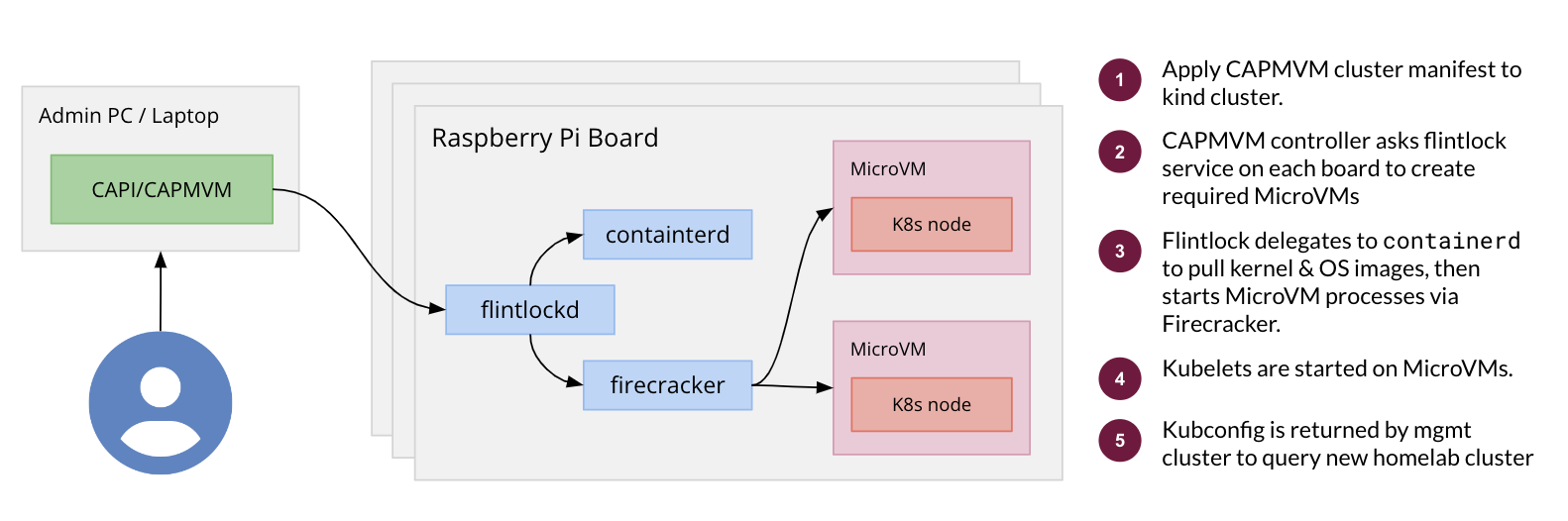
Cluster API Provider MicroVM (CAPMVM) is a Cluster API infrastructure provider. You describe a cluster as Kubernetes resources in a management cluster. CAPMVM then picks Flintlock hosts for the nodes and asks Flintlock on each host to create the microVMs. Cluster API bootstraps Kubernetes on them.
Get started
- Tutorial: Basics creates a platform and a workload cluster on your own Linux machine.
- Tutorial: Equinix runs the same on bare-metal servers in Equinix Metal.
- Tutorial: Raspberry Pi builds a cluster on a Pi rig.
- CAPMVM has more detail on the provider.